Logic is personal. It's a personal experience. It is a series of thoughts processed by yourself, however sometimes with guidance via conversation or study, which brings you to a conclusion. Logic can be taught. The mathematics of logic are robust and powerful. However, there are holes. Big holes, that still linger in the world of modern man that range across all cultures, religions, philosophies.
I want to propose the first question I have battled with. A question I didn't know (consciously) was going unanswered in my mind.
Question #1:
"How small is small enough?"
Generally small enough is decided with a degree of sufficiency based on contentment. For example, I perform an experiment and the result is found to have tiny magnitudes of error when compared to an accepted model. It is close enough? Or does this answer point to some small enigma of the unfounded complete model we are to discover later on? Is it due to chaos and unpredicted players in the equation?
Most likely the latter.
But we can never be positive.
But we generally say, close enough, I've hit it on the head.
This method of logic is still useful in this case, and can lead to further discovery.
This question is very often asked unknowingly by people who argue against the Theory of Evolution. "Well, where is the missing link for species X?" What missing link? As if an entire world-wide ecosystem of animals, showing gradual change, all linked together and laid out in a great hierarchy and a beautiful untainted perfectly-ordered fossil record timestamped by geological layers which go unattacked by unfounded scrutiny (or founded scrutiny for that matter ) isn't proof enough.
This is a flaw in logic in this case. To assume that every intermediate state in a continuous state-space should be the necessary and sufficient proof for an idea would disprove basic abstracts such as lines, circles, and even numbers.
Nothing would be accepted as plausible with this logic. The world as we know it today shouldn't exist by that logic.
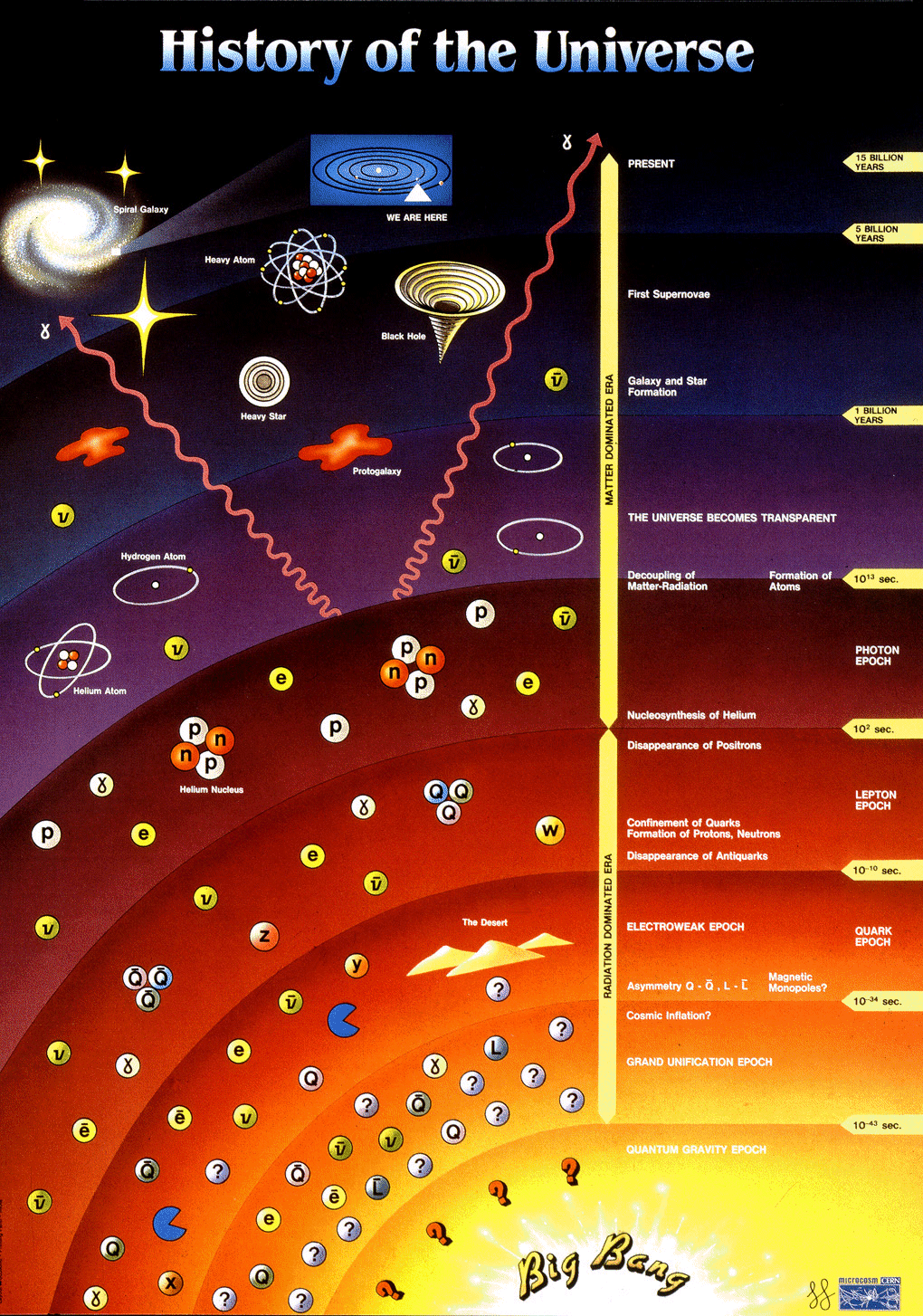
Physics is an interesting case of this. Physics continues to pursue, not only a TOE, but an answer to this question in the case of particle physics. How small is small enough? Short answer: small enough so that we have a model of the universe which predicts every causality and result with 100% accuracy. More precise answer: when we find the most basic objects which make everything or we find that everything is continuous and not quantized (quantized being the currently accepted idea).
A Philosophical Mind Experiment for Question #1
I always enjoyed stories which included a great teacher, a master of some enigmatic knowledge, a sage. So I decided I would create a mind-experiment similar to the seemingly impossible riddles they give their students to teach lessons. This mind experiment is meant to show the participant that the knowledge of all the intermediate stages of a greater picture are unimportant, as long as it is known that there are an infinite number of intermediate stages, but that the whole picture is finite. This is a fractal abstract. Even more important is how this discovery effects your life as someone looking for the truth in life, meaning in life, and importance in life.
You are standing on one side of a bridge looking to the other side. You cross the bridge once counting your steps. Every step you take is an exact distance and exactly the same every time. It took 20 steps to get across this small bridge. A man on the other side tells you to walk back doubling the amount of steps you take, making your strides half the length. 40 steps. He instructs you to continue to do this. The tenth time you do it, it takes you 20,480 steps. You are very tired and sit down to rest. The man asks, "How small is small enough effectively determine how long the bridge is?"
You would reply, this is ridiculous, the 20 steps was perfectly sufficient for measuring the bridge. The wise man would reply, "Do you take into account the minute edges of the bridge? Correct for errors on your shoes sliding ever so imperceptibly back or forth as you break friction?" You reply "That is not useful for measuring a bridge used for walking across, why are those small distances important?" The wise man replies, "Not important to you."
Measurement is meant to be useful, not perfect. No measurement is perfect, exact, or lacking room for improvement. We can only use measurements to guess. That is the way it has always worked in the history of science. Measurements are used to support theories.
- Theories will always be supported only by measurements.
- Theories will only always be implemented and applied with the help of measurements.
The wise man ends with his lesson of the day. "Every decision we make in life, every choice we make is supported with measurements we either know to some degree, assume, guess, extrapolate, or fabricate. And on the best decisions, the rest of the details we fill in with logic, scrutiny, comparison, a good measure of pessimism, a good measure then of optimism (either coming first), and generally the 'all-species-important' luck."