"To be, or not to be: that is the question:
Whether 'tis nobler in the mind to suffer
The slings and arrows of outrageous fortune,
Or to take arms against a sea of troubles,
And by opposing end them? To die: to sleep;
No more; and by a sleep to say we end
The heart-ache and the thousand natural shocks
That flesh is heir to, 'tis a consummation
Devoutly to be wish'd. To die, to sleep;
To sleep: perchance to dream: ay, there's the rub;
For in that sleep of death what dreams may come
When we have shuffled off this mortal coil,
Must give us pause: there's the respect
That makes calamity of so long life;
For who would bear the whips and scorns of time,
The oppressor's wrong, the proud man's contumely,
The pangs of disprized love, the law's delay,
The insolence of office and the spurns
That patient merit of the unworthy takes,
When he himself might his quietus make
With a bare bodkin? who would fardels bear,
To grunt and sweat under a weary life,
But that the dread of something after death,
The undiscover'd country from whose bourn
No traveller returns, puzzles the will
And makes us rather bear those ills we have
Than fly to others that we know not of?
Thus conscience does make cowards of us all;
And thus the native hue of resolution
Is sicklied o'er with the pale cast of thought,
And enterprises of great pitch and moment
With this regard their currents turn awry,
And lose the name of action." -Hamlet's soliloquy, Shakespeare's Hamlet
To me this rings truer than ever. How beautiful the words sing out, I do not only contemplate the content of this silioquy, but it's existence. These words are as real as the substance of the universe. It is an organization of its substance and thus is a real entity of the universe. In its creation William Shakespeare was the agent, the agent of creation. But was he the creator? The answer to that question is the answer to this:
"To reduce or deduce: that is is the question:
Whether 'tis more fitting to point
Downward or upward in the levels of science
Or to take arms against the very methods we hold so dear
And by opposing end them."
Reduction is the method we use to describe systems. Starting from the highest 'softest' sciences and always pointing downward, from sociology to psychology, from psychology to physiology, from physiology to biology, from biology to biochemistry, from biochemistry to chemistry, and (ultimately?) from chemistry to physics. Yet we haven't the methods yet to deduce the emergence of human beings from chemistry. We have yet to deduce the Navier-Stokes equations from quantum physics. However, there must be a connection.
The connection: complexity.
We often ignore complexity during reduction because we assume there is none... we assume only verifiable determinism within the system. However, in a complex system such as a human being, reducing to time zero would require an almost unfathomable permutation of possible initial state spaces, each point known along the path recorded and traced until we ultimately find the individual origin - the specific state space. Similarly, in the method of deduction, we must take into account fully the unpredictability of a complex system when deducing from a lower level science. An almost infinite number of paths leading to the current state of the human being. Generally speaking, the variables of any system must always depend on the variables of every other system. While we assume that we have a rock-solid control within most well designed experiments, there is always information leaking into our system other systems, and into those from other systems, and so on. This informational noise, the chaos, is often considered negligible, and so science has in the past, and for a long time in the past, turned a blind eye to implications of variation within experiments.
There is a profound implication of this: Deductively, complexity arises from order. Reductively, order arises from complexity.
I think an important note to make here is the distinguishability of chaos from complexity. Chaos within a system often occurs periodically on the path of time. Small convergences of order come from chaos. The inverse is true as well. The scale dependency of chaos also traverses this periodicity. Complexity is more often described, as my interpretation holds, as the magnitude of chaos involved in the evolution of a system.
Complexity becomes the glue of assumption. The bond between the generalized laws of the universe. In a sense, complexity is the creative force of the universe. And I intend, whole heartedly, if it takes my whole life and perhaps a thousand others, to show the existence of the glue of natural creation, the continuity of the sciences, or as Richard Feynman once put it, "the inconceivable nature of Nature!"

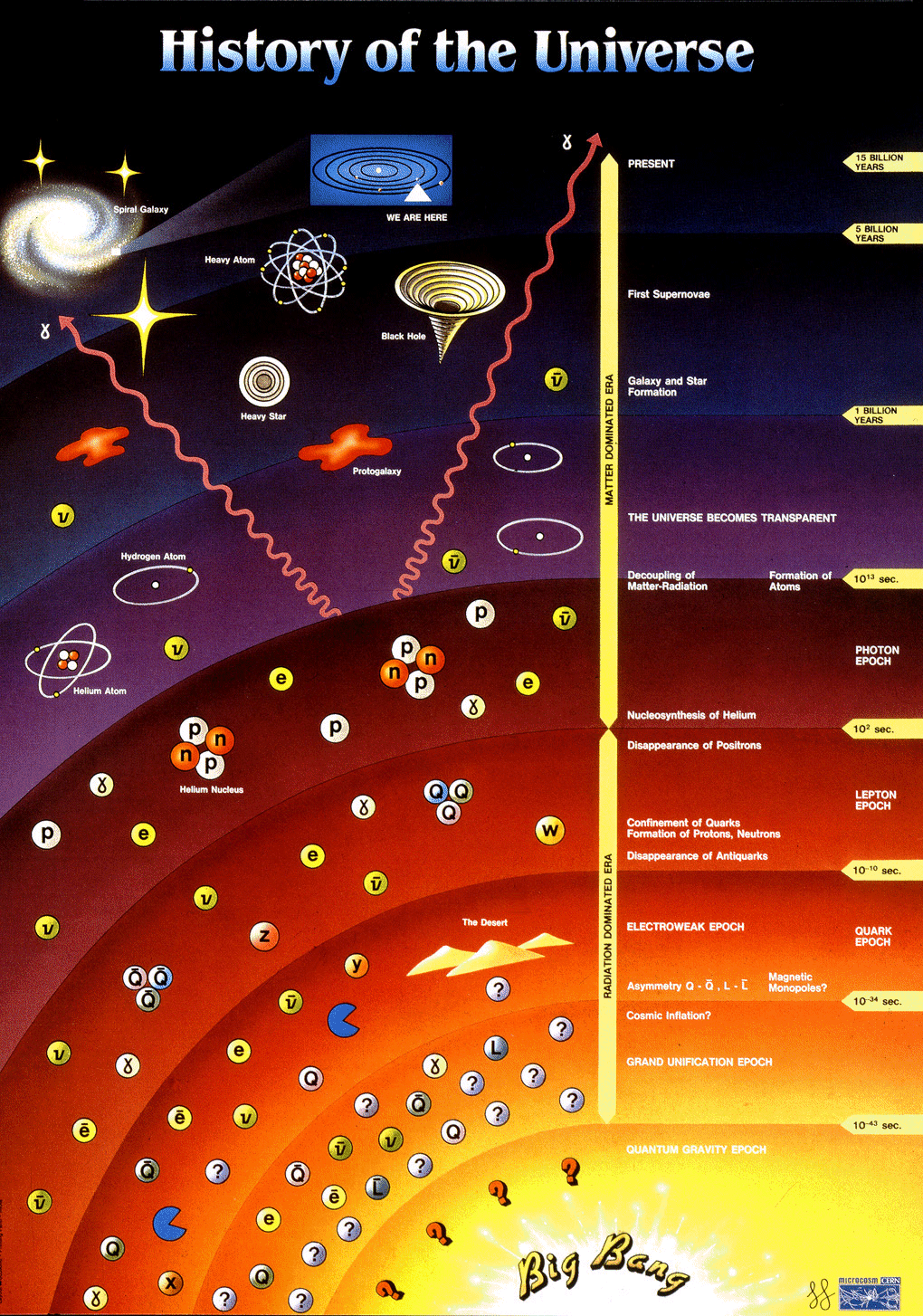
The existence of the universe is a paradox to us because we do not understand its basic nature, not because its basic nature cannot be understood. We have data, not information. I fill your search for the truth accelerates now. May we find the deductions and show your glue.
ReplyDelete